Choosing the best Drive-in Storage system begins with a clear picture of your inventory, not a rack catalogue. The U.S. Census Bureau reported that e-commerce accounted for 16.1% of U.S. retail sales in the fourth quarter of 2024. That figure does not prescribe a storage design, but it reflects the operating pressure many warehouses face: handling changing order volumes without wasting floor space.
Drive-in Storage can increase pallet density by reducing aisle space. Forklifts enter the rack lanes, so product rotation, pallet consistency, and driver procedures matter. The system often suits larger quantities of similar items, especially when last-in, first-out access is acceptable. MHI’s 2024 Annual Industry Report found that 55% of surveyed supply chain leaders planned to increase investment in supply chain innovation and technology. Still, a new system is not automatically the right investment. That matters.
Compare lane depth, pallet dimensions, load ratings, available clear height, floor condition, and forklift turning requirements. Ask a qualified rack designer to review the layout and applicable safety requirements before installation. Also examine how often each SKU moves. A deep lane may save aisle space, yet make frequently picked products harder to reach. I would not judge success by pallet capacity alone. That is an easy mistake. Consider operating flow, inspection access, and future product changes alongside density. The best choice is the one that fits your real inventory patterns, site conditions, and handling practices—not simply the one that stores the most pallets on paper.
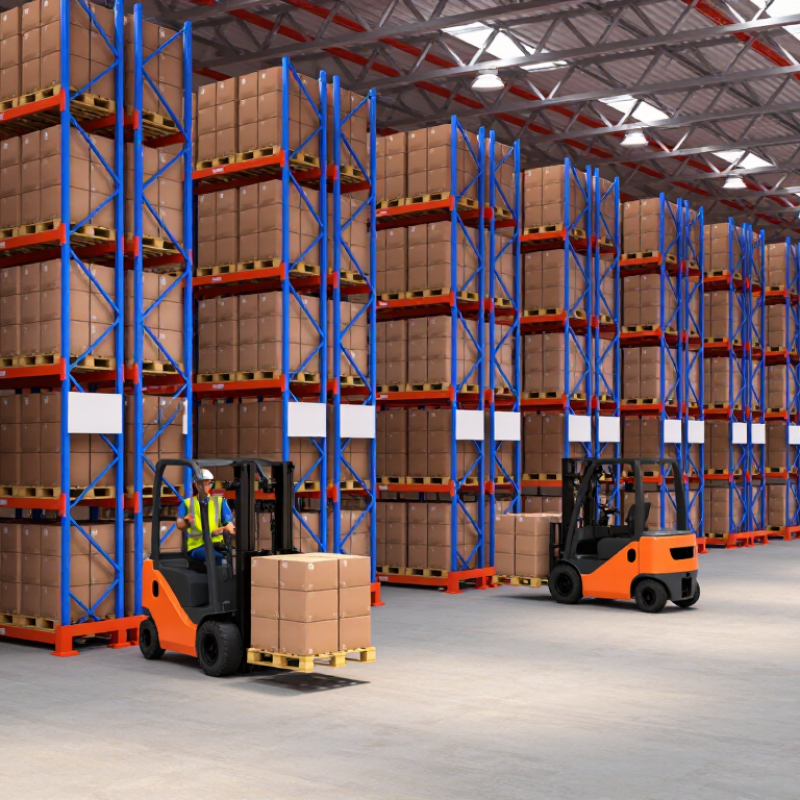
A drive-in storage system uses upright frames and horizontal rails to create deep pallet lanes. A forklift enters each lane to place or retrieve loads. There are no fixed aisles between pallet positions, so the system can use floor space efficiently. The forklift supports each pallet as it moves along the rails. In a typical drive-in layout, loading and retrieval happen from the same end, so the last pallet placed is usually the first one removed. That suits products stored in batches.
Tips: Check pallet dimensions and load weights before planning lane depth. Keep loads stable and consistent. Leave clear signs at lane entrances. Train forklift operators to enter slowly and align forks carefully.
Daily use reveals details that a drawing may miss. For example, uneven floors or damaged pallets can make deep lanes harder to operate safely. This system works best when each lane holds one product type and stock turnover is predictable. If workers need frequent access to many different items, retrieval may take longer than expected. I would review actual order patterns before choosing lane depth; storage density can look impressive, but access matters too.
A drive-in storage system suits deep, uniform pallet loads, but only when inventory patterns support limited access. Map each SKU’s pallet dimensions, daily picks, replenishment frequency, and seasonal peaks. Then check whether one lane can hold a single product without awkward mixing. Count the turns. If operators frequently need the last pallet loaded, a last-in, first-out layout may create extra handling or leave stock stranded. A tidy inventory report can miss this. Walk the lanes during a busy shift and observe actual forklift routes.
The MHI 2024 Annual Industry Report found that 55% of surveyed organizations planned to increase supply-chain technology investment. That investment makes accurate location and movement data more practical, but software cannot fix poor lane assignments. The U.S. Bureau of Labor Statistics reported a 4.8 total-recordable-case rate per 100 full-time workers in transportation and warehousing for 2022. This broad sector figure is not specific to drive-in systems, yet it reinforces the need to assess travel paths, visibility, and operator access. Measure turning space. Check lift-truck compatibility, load stability, and the time needed to reach each pallet. If fast-moving items share deep lanes with slow stock, reconsider the layout; density alone is a weak measure of fit. The trade-off is easy to underestimate.
How to Choose the Best Drive In Storage System?
Determine Storage Capacity and Warehouse Layout
Start with the inventory, not the rack dimensions. Record pallet width, depth, height, and loaded weight, then note how many pallets each product typically holds. Estimate capacity by multiplying storage lanes, levels, and pallet positions deep. Remove spaces lost to columns, uneven floor areas, and required clearances. The result is a planning estimate, not a promise. Measure twice.
Drive-in storage works best when many pallets share a product and rapid access to every pallet is not essential. Since forklifts enter the lanes, check truck width, turning space, mast height, and the operator’s sightline. A lane that looks efficient on paper can feel cramped during a busy shift. Leave room. Include staging areas and travel routes in the layout, or receiving pallets may block access to stored stock.
Match the lane design to stock rotation. Drive-in lanes generally suit last-in, first-out handling; a drive-through arrangement can support first-in, first-out access from opposite ends. Keep frequently moved products near practical travel paths, while avoiding deep lanes for items with varied demand. Review actual order and replenishment records before fixing lane depths. They may be incomplete, and seasonal patterns can make a neat capacity calculation misleading. Walk the proposed layout with forklift operators and test a sample lane using real pallets. A little unused space may be more useful than a system packed to its calculated limit.
A drive-in storage system can save floor space, but its rack layout must match your pallets and forklift. Compare lane depth, entry width, and rail spacing using the actual pallet dimensions. Deep lanes increase storage density, yet make rear pallets harder to reach. Check whether your operation suits last-in, first-out access or needs a different layout. Small mismatches matter.
Equipment compatibility deserves a close look. Confirm that forklift height, turning radius, and fork length work inside each lane. Ask how operators will position loads without striking rails or uprights. Protective guards can reduce impact damage at entry points, while clear load signs help prevent overloading. Inspect the rack regularly for bent components, loose connections, or damaged guides. One practical detail is often missed: a layout that works on paper may feel cramped during a busy shift. Test the travel path before committing.
Tips: Bring pallet samples and measure the widest load, not just the pallet base. Walk the proposed route with operators. Compare visibility, entry clearance, and protection options. A little extra aisle space may cost storage capacity, but it can make daily handling safer. Decide with real operating conditions in mind.
| Comparison Factor | Drive-In Rack | Drive-Through Rack | Push-Back Rack | Pallet-Flow Rack |
|---|---|---|---|---|
| Rack design | Forklift-accessible lanes with pallets stored several positions deep on supported rails. Usually accessed from one aisle. | Similar lane construction to drive-in, with access aisles at both ends of each lane. | Nested carts or trays sit on inclined rails within each lane; each newly loaded pallet pushes the previous pallets deeper. | Inclined lanes use gravity rollers or wheels to move pallets from the loading end to the unloading end. |
| Typical inventory rotation | Last in, first out (LIFO). Suitable when storing multiple pallets of the same product. | First in, first out (FIFO) is possible when pallets are loaded from one end and retrieved from the other. | Typically LIFO. Pallets are loaded and retrieved from the same aisle. | FIFO. Loading and picking take place at opposite ends of the lane. |
| Forklift interaction | The forklift enters the storage lane to place or retrieve pallets. Truck dimensions, turning behavior, and overhead clearance must suit the lane. | The forklift enters the lane from the relevant aisle; traffic and loading procedures must account for access at both ends. | The forklift generally stays in the aisle and places pallets onto the front cart; it does not drive into the lane. | The forklift places pallets at the loading face and retrieves them at the discharge face; it does not drive into the lane. |
| Space and access considerations | Can reduce the number of aisles compared with selective pallet racking, but access to individual pallets within a lane is limited. | Requires access aisles at both ends, but supports through-flow and separate loading and picking faces. | Offers deep storage with aisle access at the front; lane depth and cart design affect operating capacity and pallet compatibility. | Supports separate replenishment and picking faces; needs suitable lane length, floor space, and compatible pallets. |
| Best suited to | High-density storage of similar products with relatively low SKU variety and tolerance for LIFO rotation. | High-density storage where FIFO rotation and access from both ends are useful. | Multiple pallets per SKU when faster access from the aisle is preferred over forklift travel into the rack. | High-throughput operations that need FIFO rotation, such as date-sensitive or batch-controlled inventory. |
| Key equipment checks | Confirm the forklift can safely enter the lane and reach the required storage levels. Check aisle width, truck turning dimensions, mast height, and load capacity. | Check forklift clearances at both ends and establish separate, clearly managed loading and retrieval routes where needed. | Verify pallet size, weight, condition, and bottom-deck design are compatible with the carts and rails. Confirm cart movement and operating limits. | Verify pallet compatibility, lane slope, roller or wheel specification, flow speed, and any braking or speed-control devices. |
| Safety features and controls | Use engineered rack design, suitable anchorage, upright protection where exposed to impact, clear load signs, and procedures that prevent forklift contact with rack structure. | Use load signs, impact protection at exposed uprights, controlled traffic at both aisle ends, and inspections of rails, connections, and anchorage. | Protect exposed uprights, keep carts and rails in serviceable condition, display capacity information, and keep hands and people clear of moving carts. | Use appropriate pallet stops and flow-control components, protect exposed structure, keep discharge areas clear, and inspect rollers, brakes, and lane components. |
| Main trade-off | High storage density, but limited selectivity and forklift travel inside the rack can increase the risk of impact damage. | Supports FIFO flow, but needs access at both lane ends and careful coordination of traffic. | Reduces forklift entry into lanes, but uses moving carts and is generally operated as LIFO. | Provides FIFO flow, but requires compatible pallets and more specialized lane components than static rack. |
Selection note: Final design should be based on pallet dimensions and loads, SKU count, required inventory rotation, forklift specifications, building clearances, and applicable local codes. Rack capacity, anchorage, and protection should be verified by a qualified rack designer or engineer.
Choosing a drive-in storage system starts with the full cost, not just the quoted frame price. Ask for itemized estimates covering racks, anchors, installation labor, safety equipment, and floor repairs. A low bid can become expensive if site preparation is excluded. Check that the layout fits your pallet dimensions and forklift turning space. Measure twice. A narrow aisle may save floor area but slow daily work.
Installation quality affects safety and service life. Confirm who will inspect the slab, set anchors, and verify rack alignment after assembly. Request a written installation scope and completion records, including load-rating labels. If the building has uneven floors or sprinkler constraints, resolve them before ordering. Small oversights matter. A drawing can look tidy yet leave awkward clearance near a doorway; treat plans as a starting point, not proof.
Long-term support deserves equal attention. Ask how replacement parts are sourced, what response times are realistic, and whether inspections or repairs are available after installation. Keep drawings, load specifications, and maintenance notes together, so future changes do not rely on memory. Compare warranty terms carefully: coverage may exclude damage from impacts, overloading, or unapproved modifications. No system is maintenance-free. Set an annual budget for inspections and repairs, then revisit it as traffic patterns change. This helps you assess the purchase beyond day one.
It suits deep, uniform pallet loads with many pallets of the same product. Frequent access to every pallet may be difficult. That matters.
Multiply the number of lanes, levels, and pallet positions deep. Then subtract space for columns, floor irregularities, and required clearances. Treat the result as an estimate.
Review pallet dimensions, daily picks, replenishment frequency, and seasonal demand. Deep lanes can complicate access when stock moves unpredictably. Walk the lanes during a busy shift.
Drive-in lanes generally use last-in, first-out handling. A drive-through layout can allow first-in, first-out access from opposite ends. Check the rotation needs first.
Check truck width, turning space, mast height, load stability, and operator sightlines. Test a sample lane with real pallets. Paper plans can be optimistic.
Include anchors, installation labor, safety equipment, floor repairs, and site preparation. Ask for itemized estimates. A low quote may leave things out.
Confirm who checks the slab, installs anchors, and verifies rack alignment. Request completion records and load-rating labels. Small oversights matter.
Ask about replacement parts, repair availability, inspection options, and realistic response times. Keep drawings and maintenance notes together. Memory fades.
Budget for annual inspections and repairs, then review the budget as traffic changes. Check warranty exclusions for impacts, overloading, or unapproved modifications. No system is maintenance-free.
Choosing the best Drive-in Storage system starts with understanding how it works: forklifts enter the rack lanes to place and retrieve goods, making the design useful for storing multiple pallets of similar products. Before selecting a system, assess the inventory you handle, including pallet dimensions, product turnover, and the material-handling equipment available. These factors help determine whether the system suits your daily picking and replenishment needs.
Next, estimate the required storage capacity and consider how rack lanes will fit into the warehouse layout, including aisle access and workflow. Compare rack designs, load requirements, equipment compatibility, and safety features to support reliable operation. Finally, look beyond the initial purchase price by reviewing installation needs, maintenance, and long-term support. A well-matched system can make effective use of available space while keeping storage operations practical and safe.

GuciRack