China’s Push-Back Storage industry is gaining attention as warehouses demand higher density without sacrificing selectivity. Push-back racking can store multiple pallets deep, using inclined rails and gravity-driven movement. Forklifts remain in the aisle. Storage depth does the quiet work.
The market context is significant. The 2024 MHI Annual Industry Report found that 83% of supply-chain professionals planned to increase technology investment. Deloitte’s 2024 manufacturing survey also reported continuing pressure to improve warehouse productivity, resilience, and labor efficiency. These findings do not measure Push-Back Storage directly. That limitation matters. Still, they explain why dense, semi-automated storage systems are attracting serious buyers.
John Paxton, former CEO of MHI and a recognized material-handling industry expert, stated, “The need to invest in technology and innovation has never been greater.” His observation fits modern racking decisions, but technology alone cannot fix poor warehouse planning. A low-quality rail, uneven loading, or weak pallet discipline can create delays beside an otherwise impressive rack.
This China Top 10 Push-Back Storage Manufacturers guide examines manufacturers through practical criteria. These include load capacity, beam and rail quality, powder-coating consistency, seismic design experience, installation support, testing procedures, and export documentation. Factory audits, engineering drawings, and customer references deserve attention. Product photographs are not enough.
The strongest supplier may not be the cheapest. It should match pallet dimensions, turnover rates, forklift clearances, and local safety requirements. Buyers should verify every claim. A careful comparison can reduce dead space, improve selectivity, and support safer daily operations.
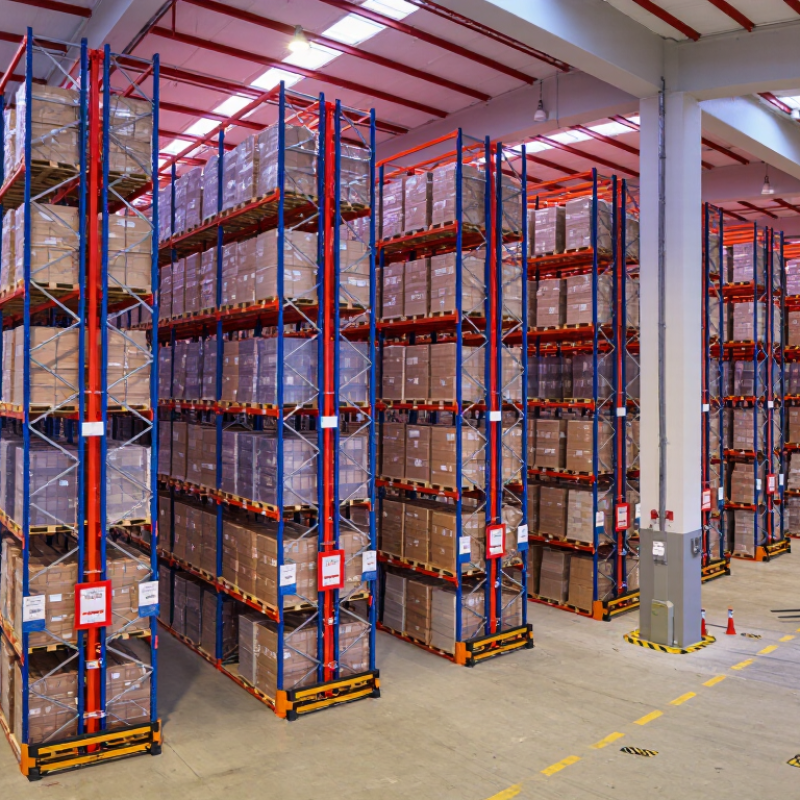
Push-back racking is designed for LIFO storage, with each lane holding two to six pallets in depth. Forklifts load pallets from the front, pushing earlier loads toward the rear. During retrieval, the front pallet leaves first. The carts then return by gravity or controlled movement. Simple, but not universal.
The system suits warehouses storing several pallets of the same SKU. It reduces aisles compared with selective racking and uses vertical space efficiently. A six-pallet lane can hold more inventory, yet access becomes less flexible. Mixed products may create hidden stock and slower picking. That trade-off is easy to underestimate.
The 2024 MHI Annual Industry Report reported cloud computing use among 55% of surveyed supply-chain organizations, while 38% used robotics and automation. Push-back racking is not fully automated, but it supports structured material flow and can complement digital inventory control. In a practical layout review, aisle width, pallet condition, load stability, and forklift visibility matter greatly. A 2-deep lane may outperform a 6-deep lane when SKU variety is high. More capacity is not always better.
Manufacturers in China commonly engineer systems across the 2–6 pallet-depth range. Buyers should request tested load ratings, cart travel details, beam tolerances, and maintenance guidance. The weakest assumption deserves attention: LIFO works only when product rotation and replenishment rules are clearly controlled.
| Configuration | Storage Depth | Typical Pallet Positions per Lane | Loading and Retrieval Principle | Suitable Inventory Rotation | Typical Forklift Requirement | Typical Load Range per Pallet | Space-Utilization Benefit | Best-Fit Applications |
|---|---|---|---|---|---|---|---|---|
| Profile 01 | 2 pallets deep | 2 | Each newly loaded pallet pushes the previous pallet toward the rear; the front pallet is retrieved first. | LIFO | Reach truck or counterbalance forklift | Project-specific; commonly engineered for approximately 500–1,500 kg | Higher density than single-deep selective storage while retaining direct access to the front pallet. | Fast-moving products with limited stock-keeping units and repeated batch storage. |
| Profile 02 | 2 pallets deep | 2 | Inclined rails or carts allow the rear pallet to move forward after the front pallet is removed. | LIFO | Reach truck with suitable lift height | Capacity must be verified against pallet weight, frame height, rail span, and cart design. | Reduces aisle demand compared with many conventional pallet-rack layouts. | Cold rooms, reserve storage, and batch-controlled distribution areas. |
| Profile 03 | 3 pallets deep | 3 | Forklift loading takes place from the aisle; pallets are stored on nested carts or movable platforms. | LIFO | Reach truck generally preferred for improved aisle maneuverability | Usually designed around the facility’s standard pallet and verified structural calculations. | Provides a practical balance between density and lane accessibility. | Seasonal inventory, packaged food, beverages, and manufacturing buffer stock. |
| Profile 04 | 3 pallets deep | 3 | Gravity-assisted movement returns stored pallets toward the loading face after retrieval. | LIFO | Counterbalance or reach forklift, depending on aisle width | Rated load is determined by rail loading, cart loading, beam levels, and seismic requirements. | Improves floor-space use by combining vertical storage with reduced aisle repetition. | Homogeneous pallet batches requiring last-in, first-out handling. |
| Profile 05 | 4 pallets deep | 4 | The forklift places each additional pallet behind the previous pallet, moving the stored sequence deeper into the lane. | LIFO | Reach truck or turret-compatible handling equipment, subject to layout | Engineering value varies with pallet dimensions, cart count, rail length, and frame configuration. | Can materially increase pallet density where the number of SKUs is controlled. | High-volume reserve storage and production replenishment stock. |
| Profile 06 | 4 pallets deep | 4 | Independent lanes allow separate batches to be stored without requiring access to adjacent lanes. | LIFO | Forklift with adequate residual capacity at the required lift height | Final capacity should be confirmed using rack calculations and the actual pallet gross weight. | Offers better selectivity than drive-in storage for multiple product batches. | Distribution centers storing several pallets per SKU or lot. |
| Profile 07 | 5 pallets deep | 5 | Nested carts or rollers support controlled pallet movement toward the aisle during unloading. | LIFO | Reach truck commonly used to limit aisle width and improve positioning accuracy | Load ratings are not universal and must be matched to the complete rack and cart system. | High-density storage is achieved with fewer operating aisles per stored pallet. | Bulk reserve inventory, beverage storage, and stable product families. |
| Profile 08 | 5 pallets deep | 5 | Front-facing loading and unloading avoids driving a forklift into the storage lane. | LIFO | Reach truck or narrow-aisle forklift selected from the site layout | Common pallet loads may range from light to heavy duty, but the certified design rating controls operation. | Provides strong cubic utilization while maintaining aisle-side access. | Low-SKU environments with predictable replenishment cycles. |
| Profile 09 | 6 pallets deep | 6 | Each lane operates as a compact LIFO storage channel with multiple pallets arranged behind the loading face. | LIFO | High-reach equipment may be required depending on ceiling height and rack elevation | Capacity depends on total lane load, cart quantity, rail deflection limits, and local code requirements. | Maximizes storage density for uniform products with low access frequency. | Large-volume reserve stock and long production or replenishment batches. |
| Profile 10 | 6 pallets deep | 6 | Rear pallets remain inaccessible until the front pallets have been removed, making strict batch sequencing essential. | LIFO | Forklift type must be selected using aisle width, lift height, pallet dimensions, and residual capacity. | Use only the rated capacity shown on the approved engineering documentation and rack signage. | Delivers the highest density in this comparison but the lowest selectivity for individual pallets. | Uniform, non-perishable, or date-insensitive goods managed in large batches. |
| Technical note: Push-back racking is generally a LIFO system. Actual pallet capacity, rack height, aisle width, cart type, rail inclination, seismic design, and forklift compatibility must be confirmed through a site-specific structural calculation and the applicable local safety standards. FIFO rotation is normally better served by pallet-flow racking. | ||||||||
The system should match the planned pallet load, from 500 to 1,500 kilograms. A 500-kilogram pallet needs different steel and testing than a 1,500-kilogram pallet. Do not trust maximum figures alone.
Look for coil slitting, roll forming, robotic welding, coating, inspection, and load testing. A workshop performing only assembly may offer less process control. Factory photos are not enough.
Request mill certificates, coating thickness records, weld inspection procedures, and load-test results. Confirm the tested range. Ask whether capacity means per level, bay, or pallet.
Push-back systems commonly use two to five levels. Typical heights range from three to six meters. More levels do not always improve warehouse performance.
Carts move along sloped rails through gravity-assisted lanes. Guides, rollers, and stops control pallet movement. Uneven loading can create sudden impacts.
Drawings cannot reveal every operating problem. Engineers should check wheel movement, stopping distance, rail condition, and forklift clearance. Real pallets expose awkward details.
Yes. A five-level design may slow access when workers frequently need front pallets. Operators might wait while pallets clear. The design can be technically correct but operationally weak.
Floor flatness, dust, temperature, forklift impact, and maintenance access can change performance. Uneven floors deserve attention. Load signs and routine inspections should remain visible.
Compare certified test data with the actual warehouse layout and handling equipment. Check loading conditions and pallet dimensions. I would remain cautious when test conditions are missing.
Push-Back Storage is a high-density pallet system designed for LIFO inventory management, allowing pallets to be stored two to six positions deep while reducing aisle requirements. This article presents China’s top 10 manufacturers based on production capability, customization options, and systems commonly rated for 500–1,500 kg per pallet. It explains typical configurations of two to five storage levels and heights of approximately 3–6 meters, including the role of carts, rails, and pallet loading mechanics.
The guide also reviews key technical considerations, such as EN 15512 and FEM 10.2.02 principles, suitable steel grades, structural calculations, stability checks, and safety testing. For supplier selection, readers should compare space utilization, manufacturing lead times, installation support, warranty coverage, spare-part availability, and expected return on investment. A careful evaluation helps ensure the selected system matches warehouse layout, pallet dimensions, product turnover, handling equipment, and long-term operational goals.

 GuciRack